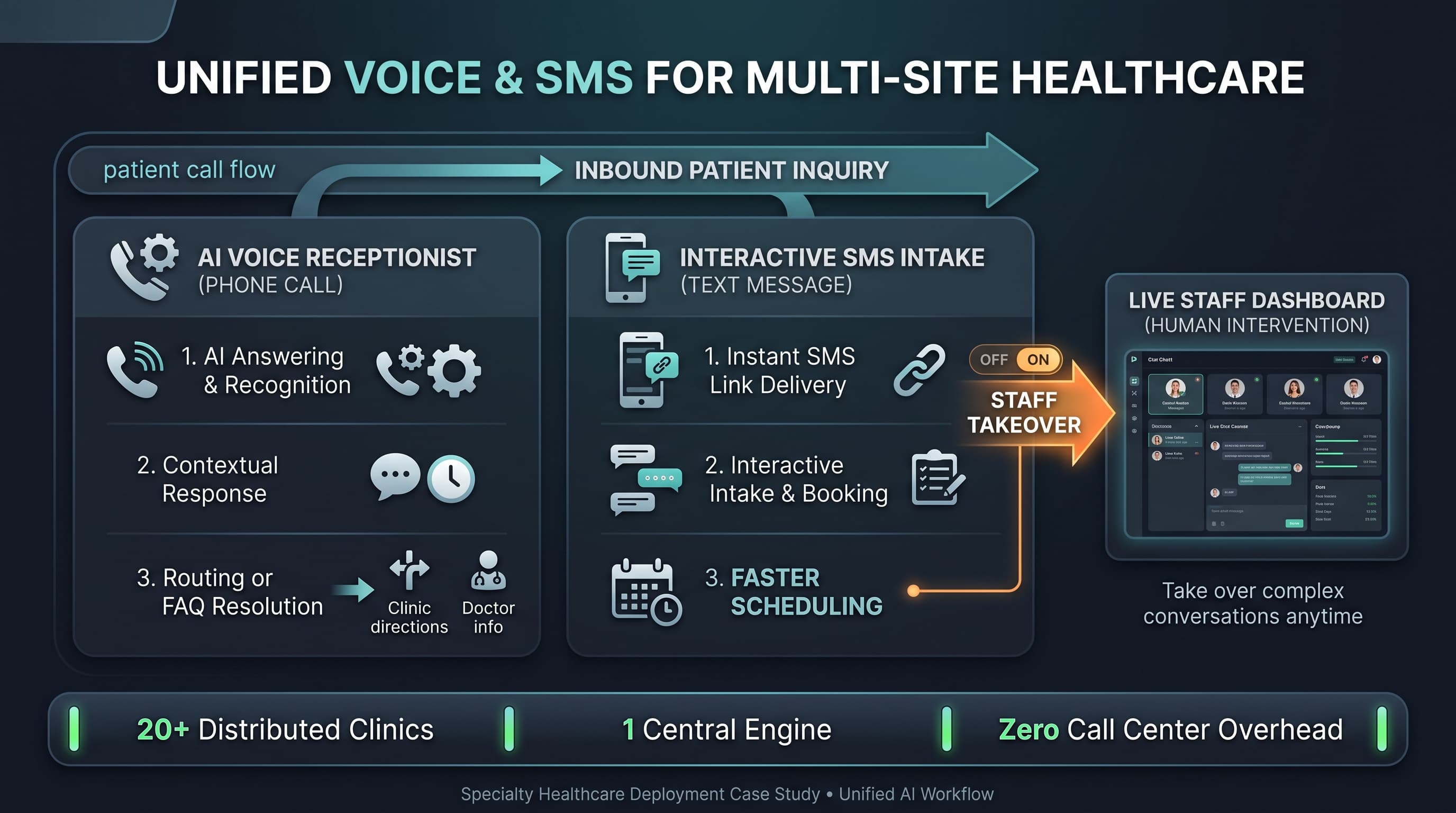
Managing a high volume of inbound support inquiries strains even the most experienced front-office and customer service teams. When lines stay busy, customer friction rises, leading to abandoned carts, unbooked appointments, and missed business calls. Integrating a dedicated AI voice agent for customer calls allows your business to capture every opportunity without forcing you to continuously add to your headcount.
An automated phone answering system eliminates the bottleneck of traditional call queues. It answers instantly, gathers clear details, and resolves issues on the spot or routes the conversation cleanly to your team.
Why an AI voice agent for customer calls matters
When your operations rely heavily on telephone availability, a single missed call represents lost revenue. Front desk automation protects your staff from hitting a breaking point during peak inquiry hours. Instead of spending hours listening to generic voicemail recordings or chasing down cold call-backs, your team can focus on complex customer needs that require a human touch.
Furthermore, scheduling leaks occur when customers cannot get immediate answers after business hours. A modern business must remain reachable around the clock to handle inquiries before prospects move on to a competitor.
How it works in practice
Set your own "call forwarding" rules for when a customer calls your main office number and no one is available. For example, your phones ring 3 times and if no one answers, the AI voice agent picks up. Rather than playing a static menu option, the system engages in a natural conversation to establish the caller's intent.
If a customer wants to schedule a service, confirm a booking, or update their billing information, the system safely processes the data and executes the task directly. For specialized inquiries, the platform structures the conversation details into a concise text summary and routes the live call to the exact team member equipped to handle it.
What to evaluate before choosing a solution
Before integrating automated voice tools into your operations, review these practical buying criteria:
Workflow fit: Can the software mirror your exact team routing logic and standard operating procedures?
Escalation handling: Does the platform transfer calls smoothly to live agents with full context when a problem is too complex?
Booking boundaries: Can you control what schedules, appointments, or workflows the automated agent can access?
Patient/customer communication quality: Is the speech pacing and tone professional, accurate, and easy for callers to understand?
Rollout burden: Can your business deploy the technology in a few days without overhauling your existing network infrastructure?
Staff control: Does your team retain immediate visibility into call transcriptions, metrics, and logs?
Common mistakes or risks
A common pitfall is implementing rigid, legacy IVR systems disguised as modern voice tools. These systems frustrate customers by forcing them through long dial menus, which increases abandonment rates.
Another operational risk is failing to set clear boundaries for the automation. If the voice system tries to answer questions outside its pre-defined knowledge base, it can provide inaccurate information, creating confusion and adding a correction burden to your internal staff.
How Powervox approaches this
Powervox provides a highly customizable framework designed to handle customer calls with the same standard as your top-performing team members. Our approach focuses on building custom AI voice agents that execute your specific corporate workflows without friction.
With Powervox, you are not locked into a rigid, pre-built template. Our drag-and-drop workflow builder allows operations managers or tech leads to explicitly define what the agent says, when it should escalate a call, and how it handles data. Every single call handled by our system is instantly logged, recorded, and transcribed, giving your team absolute transparency and control over your communication channels.
FAQ
Can this system handle multiple customer calls at the exact same time?
Yes. The platform is built to manage multiple simultaneous inbound calls, completely eliminating busy signals and hold times for your customers.
How does the system integrate with our existing software tools?
The platform features robust API support and links with common software suites, allowing it to read and write scheduling or customer data safely without manual data entry.
What happens if a caller gets frustrated or asks for a supervisor?
The agent detects specific sentiment keywords or direct requests for a manager and immediately routes the call to your designated live team member along with a transcription of the chat.
Next step
Stop letting long hold times and missed calls impact your bottom line. Give your operational team the automated backup they need to keep operations smooth. Discover how Powervox transforms inbound call management today.